Origin
I've been trying to get into iOS app development since the App Store opened. I started a lot of tutorials over the years and ended every one of them in tutorial hell. The code worked but I didn't really understand it. The next project never started.
That broke when I found Chris Eidhof and Daniel Eggert's Swift Talk. Their four-episode arc on building a Bento box layout in SwiftUI was the first tutorial I followed all the way through AND understood the code at the end of. Layout finally clicked: how SwiftUI uses it to shape a screen, why constraints are the structural answer.
I didn't stop when the videos ended. I kept asking what else I could do with this. I added a grid. I gave the cells some colorful styling.
Then I wondered: can I split and combine these cells with a swipe?
The floodgates opened.
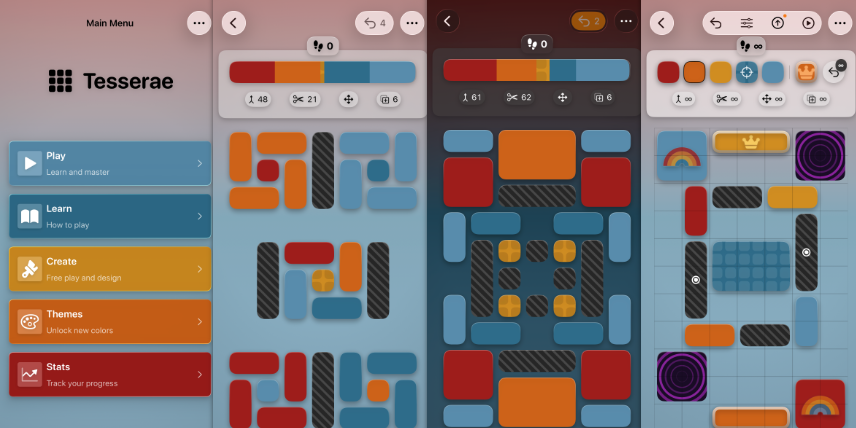
Swipe a cell toward another cell, they merge. Swipe a cell toward empty space, it splits. At that point I knew this wasn't a tutorial project anymore. Tesserae was born.
Merge. Split. Shift. Clone.
I made it out of tutorial hell, now I just need to make it out of release hell.
What's underneath
The game is Swift 6 strict concurrency on iOS 26's Liquid Glass design language. SeaBearKit lives in production here: the palette system that makes Tesserae's color schemes feel like one app, the persistent navigation background that keeps the puzzle's mood from flickering between screens, the glass shadows that let the chrome feel native.
The design lives in the notes.